
 simona pilolla 2/Shutterstock
Working at an RV park for nearly a decade taught me a lot of things. One major lesson was how easily things can and do go wrong, from luxury diesel pushers that became lemons after driving off the lot to the impact a fender-bender can have on that fiberglass exterior. Although in most places, you don't need a special license to drive an RV, there is a lot to know about staying safe both on and off the road.
To that end, there are some guidelines that both drivers and passengers have to follow. Just as you want to avoid distractions while operating a car, you also want to make sure you're completely focused while driving 20,000 pounds of metal, plastic, and more down the highway. Beyond the behind-the-wheel skillset, it's also crucial to follow local laws. After all, you don't want to wind up with a ticket or worse during your next RV trip.
Ride in a towed RV
 Gulf Stream Coach Inc.
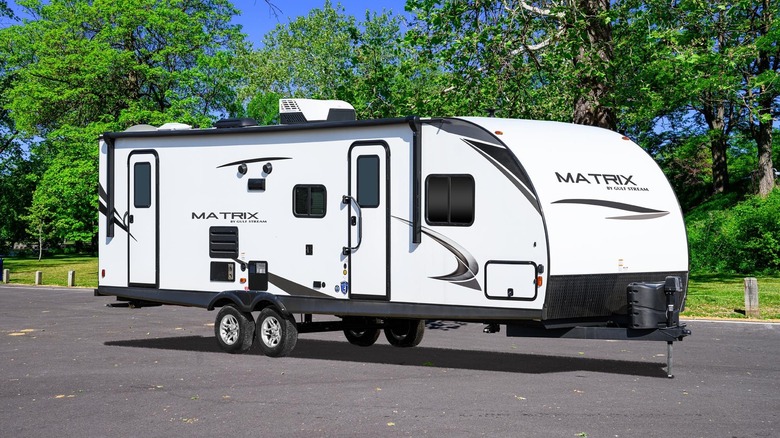
When it comes to the term "RV," recreational vehicles can include anything from bumper-pull trailers to fifth wheels to motorhomes. Different rules apply to various types of RVs, because in some cases it's like driving a giant car (motorhomes) and in others, you're towing an entirely separate vehicle behind you (fifth wheel or trailer).
With travel trailers, specifically, passengers are banned from doing certain things while the RV is on the road. Since travel trailers are connected to the towing vehicle by way of a hitch, it's generally considered unsafe to ride in one while it's being towed down the road. Many states have laws on the books regarding passengers riding in towed trailers, and they disallow that particular activity.
Though some states outright ban the activity, others have looser guidelines. For example, California does not allow passengers in a towed "trailer coach," but says passengers can ride in a fifth wheel while it's being towed. Travel trailers that are called fifth wheels have a different design from bumper-pull trailers, and they connect to the towing vehicle differently, too. Either way, riding in a towed trailer is a no-no in a lot of places, and you're unlikely to find seatbelts in this type of RV anyway — which makes the whole venture a moot point due to seatbelt laws.
Walk around in the RV
 Grand Design RV
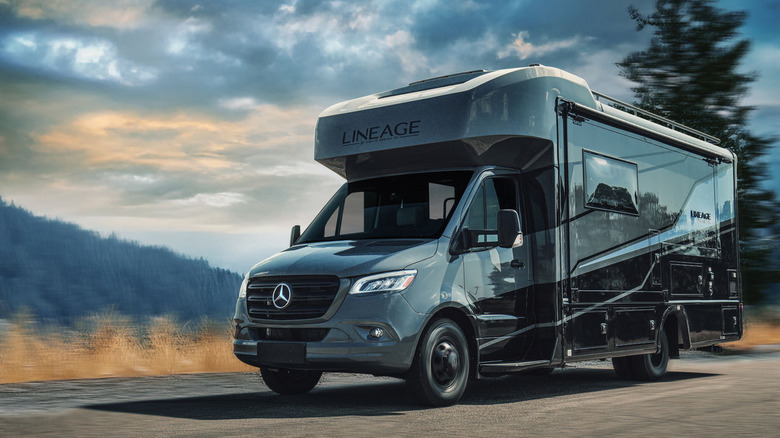
You might expect that RVs would have different rules from regular vehicles operating on roadways in the U.S. Unfortunately, your party bus-esque RV is still subject to many of the same rules as a standard automobile, especially when it comes to passenger safety.
One simple activity that passengers are not allowed to partake in is moving about the cabin. Unlike flying on a plane, passengers aren't meant to move around in RVs while they're barreling down the freeway. That's mainly due to seatbelt laws, which exist in most states and restrict passengers to staying in their assigned seats throughout the road trip.
In fact, seatbelt laws in the U.S. cover all but one state that doesn't require adults to wear seatbelts. In most states, you will need to stay belted up as an RV passenger, and you must be seated in a position equipped with seatbelts. That means, depending on the configuration of your RV, you probably can't watch TV in your RV (or camper) until the rig stops.
Take a nap in the back
 Forest River RV
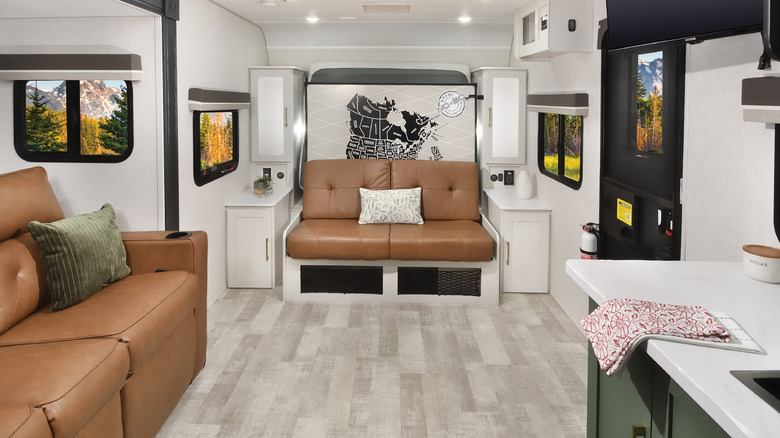
Part of the appeal of traveling via a recreational vehicle is the fact that you have all kinds of amenities and creature comforts onboard. The bathroom is a major perk, for one thing, but you might imagine you can also head to the kitchen for some snacks, lounge in bed for the duration of a trip from Point A to Point B, or hang out on the couch. Unfortunately, that is not the case in most states, due to the simple reality of seatbelt laws.
Considering the fact that RVs only have seatbelts in specific places, you can understand why it's not permitted for passengers to take a nap in the back while an RV is on the road. Given how many additional hazards come into play during a crash, literally everything that's not nailed down can become a projectile — an RV can be even less safe.
Projectiles can be responsible for countless injuries, ranging from lacerations to fractures and even traumatic brain injuries, and that's only in a regular automobile. You probably don't want to imagine everything in your RV cabinets spilling out in a rollover situation, or appliances sliding around when you take corners too fast.
Install a car seat
 Winnebago
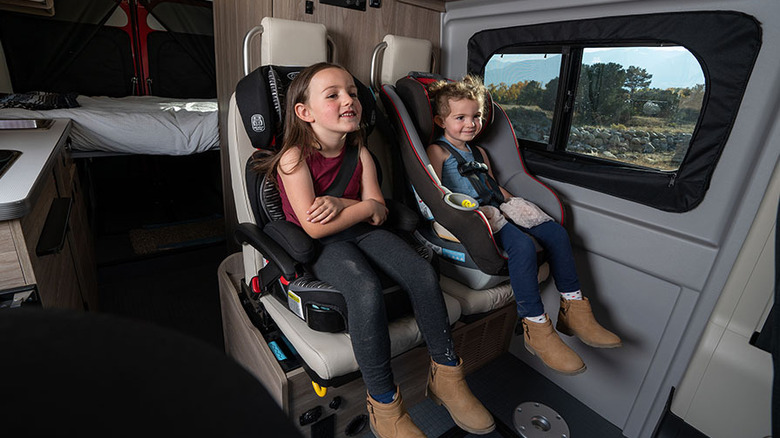
When it comes to family road tripping, can you imagine a more convenient mode of transportation than an RV? Especially if you rent or buy a motorhome, you might think toting a gaggle of kids around just became that much easier. Install their car seats, load up their gear, and go — no schlepping luggage through the airport, no crying babies at 30,000 feet, and the ability to pull over to find a toy, snack, or whatever else your kids need in a pinch.
Before you start perusing RV sales sites, consider the fact that installing a car seat in an RV may not be the best idea — and in some cases, it's against the law. For whatever reason, not all RV seats are required by law to have seatbelts, and even when they are, they might not meet requirements for a child safety seat.
Whether the RV you're considering is equipped with child safety seat accommodations is just one of the many things to think about when buying a used RV. However, checking your child's car seat manual is also solid advice, because manufacturers sometimes have specific requirements for their products. If you're wondering why RVs are different from school buses, where child safety seats are also uncommon, the reason school buses don't have seatbelts is due to compartmentalization. In short, school buses have energy-absorbing seat backs and other protections, sans seatbelts — and RVs don't.
Drink anywhere you want
 Venture RV
If you're disappointed to find out that traveling in an RV is not as freeing as you would expect, prepare to be even more so. Considering that it can even be illegal to live in an RV, though, maybe you're not that surprised. When it comes to things like open containers on the road, however, RVs are not the place to get your party on.
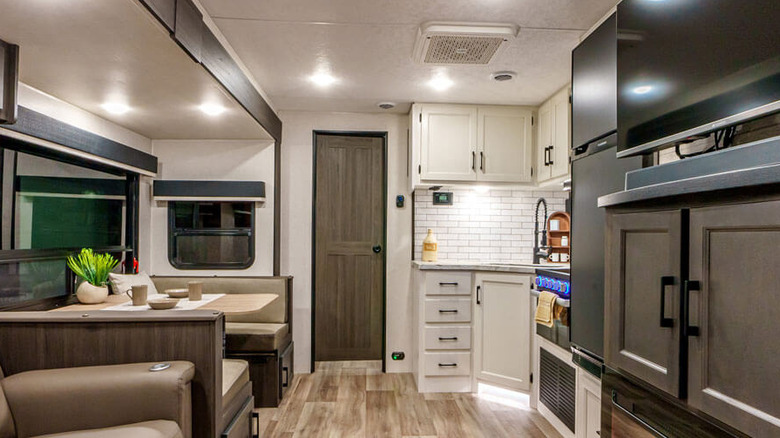
In general, RVs are treated the same way as your average motor vehicle, in that you cannot have an open container of alcohol in your cupholder while driving (or riding shotgun). However, because a motorhome generally includes a separate kitchen or living area, you may be allowed to have open containers stored there.
Open container laws have exceptions for the living quarters of RVs only. Unfortunately, that doesn't mean you can sit in the back seat of the RV sipping on your cocktail. That's due to other restrictions on RV passengers, primarily seatbelt laws. Essentially, you can't drink in most areas of an RV, and because each state's open container laws can vary, it's safest to imbibe once you arrive at your destination.